


It's probably happened to you: you have to send a package, you grab a random box, put the product in it, and when you get to the shipping agency, they give you a much higher price than you expected. "But it doesn't weigh anything!" you think.
Here's the secret: space is money.
Today, we're going to explain in a very simple way how to calculate the real volume of a box, what that scary "volumetric weight" is, and we're introducing our new free tool: the TeleCajas Smart Calc.
The basic formula (what we learned in school)
To know how much space a cardboard box occupies, the math is very simple. You just need to multiply its three dimensions.
Formula: Length × Width × Height
If you measure in centimeters (cm), the result will be in cubic centimeters (cm³).
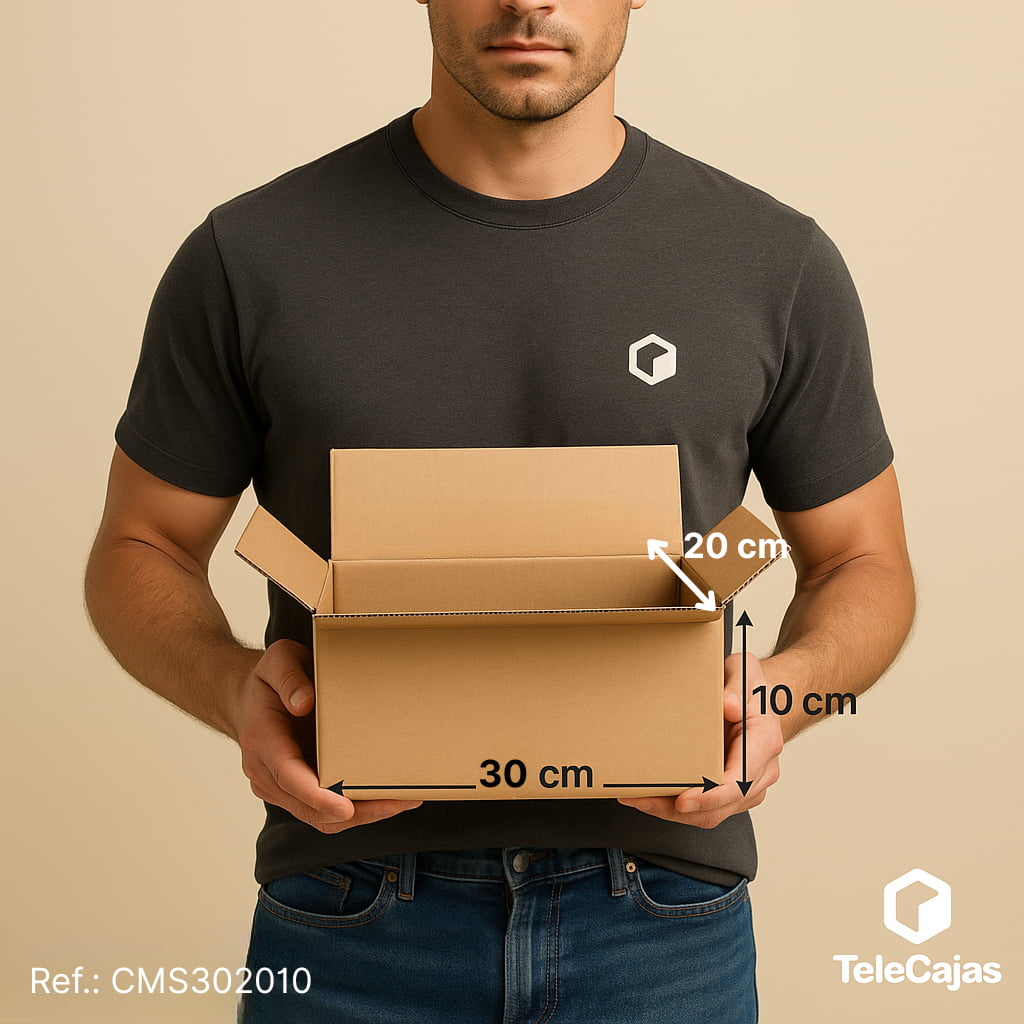
A quick example: Imagine a standard shoe box 30 cm long, 20 cm wide, and 15 cm high.
-
30 × 20 × 15 = 9,000 cm³
What does this mean in Liters or Cubic Meters?
Sometimes, seeing a number as large as 9,000 can be a bit overwhelming.
-
In Liters: Divide by 1,000. That box has a capacity of 9 Liters.
-
In Cubic Meters (m³): Divide by 1,000,000. That box occupies 0.009 m³. This data is vital if you're renting a storage unit or filling a pallet.
To calculate the cubic meter of a box: length × width × height in centimeters, divided by 1,000,000; that is the unit of measurement in cubic meters. Below you have the meter calculator (and the calculator page) so you don't have to do it manually.
The Agencies' "Trick": Volumetric Weight
This is where most people lose money. Shipping companies (Correos, SEUR, DHL, etc.) don't just charge for what the package weighs on the scale (actual weight), but for the space it occupies in their van.
Imagine you send a huge box full of feathers. It weighs nothing, but it takes up half a truck. The carrier would lose money. That's why they invented Volumetric Weight.
How is it calculated?
You take the volume of your box and divide it by a "Conversion Factor."
-
The standard (5000): This is the most common for urgent and standard parcel shipments.
-
The strict (4000): Used by some international companies (it's more expensive for you).
-
The economical (6000): Used for ground freight or slow shipments (it's cheaper for you).
Try our Smart Calculator (TeleCajas Smart Calc)
We know that constantly doing calculations on your phone's calculator is a hassle. That's why we've created this interactive tool right below. If you prefer the tool on its own page, use the box volume and volumetric weight calculator.
Volume Calculator
TeleCajas Smart Calc

You've got the volume. Now pick a box that actually fits (and stop paying for empty air).
What does this calculator do for you?
Unlike a normal calculator, the TeleCajas Smart Calc is designed with real logistics in mind:
- Real-time 3D visualization: As you type in the measurements, our interactive 3D cube changes shape so you can see what your box will look like in reality.
- Automatic Space (m³) calculation: Ideal if you're planning a move or need to know how many boxes fit in your car boot.
-
Volumetric Weight Detector: Choose the shipping type (Standard 5000, Economical 6000, etc.) and the calculator will tell you the "chargeable Kg".
- Pro Tip: If the "Volumetric Weight" is greater than the actual weight of your items, you will be charged for the volumetric weight. Use a more fitted box to save money!
Volume of the most popular boxes
So you don't have to calculate every time, here's the volume of the best-selling moving and shipping boxes:
| Measurements (cm) | cm³ | Liters | m³ | Recommended use |
|---|---|---|---|---|
| 40 × 30 × 30 | 36,000 | 36 L | 0.036 | Books, heavy items |
| 50 × 35 × 35 | 61,250 | 61 L | 0.061 | General use, vinyl records |
| 60 × 40 × 40 | 96,000 | 96 L | 0.096 | Clothes, textiles, light items |
| 80 × 60 × 55 | 264,000 | 264 L | 0.264 | Bulky items, storage |
You can see all moving boxes in our catalog with over 200 available sizes.
For pallet shipments, the reference is the 80×60×55 cm trunk box. Other large formats can be found under large and giant boxes.

How to calculate volume in liters?
When we talk about the volume of a cardboard box, we usually do so in liters. The conversion is very simple:
- Divide by 1,000 to convert from cm³ to liters
- Divide by 1,000,000 to convert from cm³ to m³
1,000 cm³ = 1 Liter
Length (cm) × Width (cm) × Height (cm) = Volume (cm³) ÷ 1,000 = Liters
Example with our 60×40×40 cm moving box:
60 × 40 × 40 = 96,000 cm³ ÷ 1,000 = 96 liters
This data is very important for knowing the space the box occupies when stored or transported, and it is crucial when requesting quotes from parcel companies.
Quick conversion table
| From | To | Operation |
|---|---|---|
| cm³ | Liters | ÷ 1,000 |
| cm³ | m³ | ÷ 1,000,000 |
| Liters | m³ | ÷ 1,000 |
| mm³ | Liters | ÷ 1,000,000 |
Volumetric weight: why size matters (a lot)
Choosing the right box isn't just about protection; it's about saving money. Shipping companies don't just charge for what the package weighs on the scale (actual weight), but for the space it occupies in their van.
To calculate volumetric weight, you divide the volume by a "conversion factor" that varies depending on the carrier:
- Factor 5000 — Most common for urgent and standard parcel shipments
- Factor 4000 — Stricter, used for international shipments (more expensive)
- Factor 6000 — Economical, for ground transport or slow shipments
Example with our 60×40×40 cm box and an actual weight of 5 kg:
96,000 cm³ ÷ 5,000 = 19.2 kg (volumetric weight)
Since the volumetric weight (19.2 kg) is greater than the actual weight (5 kg), you will be charged 19.2 kg. If the box weighed 22 kg, the chargeable weight would be 22 kg, because the higher value is always charged.
Saving tip: Using a box that's too large can double your shipping cost. Always pick the box that best fits your product. Use the box size finder or go straight to American flap boxes. At TeleCajas you've got over 200 sizes to find the right one.
Are you preparing to move and want to calculate how many boxes you need? Check out our guide: How Many Boxes Do You Need for Your Move?






I have 24 boxes of bellow with floowing dimentions , i need to know how many CBM i might consider to the whole boxes ?
42×32×45 = 8 boxes
47×35×30 = 8 boxes
63×47×45 = 8 boxes
Buen día si yo quiero traer 5 pares en cajas de zapatos en un bulto completo, cuántos pares podría yo colocarlo en un bulto con sus cajas
Le agradecemos su valoración y nos alegra que le haya sido util. El sistema decimal europeo se usa el punto “.” para la separacion de millar y la coma “,” para los decimales. Deberiamos haberlo avisado, vamos a editar post. Saludos cordiales!
Todo muy bien pero me confundí con el uso del punto ya que para poner mil ustedes pusieron 1.000 y para mi eso es uno…saludos…y muchas gracias.
Buenas tardes, muchas gracias ias por compartir tan clara información.
Soy lic en Comercio Internacional y despachante de Aduanas, estaba sacando un costo de contenedor de 20 ’ y justo apareció su empresa, que pese a ser un dato doméstico fue de gran utilidad.
Saludos!